What follows may well be self indulgent prose on how I got this game from an idea to reality - so be it. This is how I got there; my little journey if you will.
The Battle of Borodino holds a peculiar fascination for me
and judging by bloggers and forum chat it captivates many other gamers too.
This isn’t the place to write a history of the 1812 campaign so simply put this
is where the Russian Armies of the West finally turned and stood in front on
Moscow.
Bonaparte had at his disposal possibly the finest formations
he ever commanded and a roster of Marshalls with an impressive track record. He
had chased the Russians across European Russia in an attempt to bring them to
battle, destroy them in the field and capture Moscow. Why then when they turned
to fight did he use this fabulous army as a mere “blunt instrument”? Why did he
ignore the sage advice of his Marshalls to manoeuvre? I have no idea. The
outcome was a one day battle during which the Grand Armee frontally stormed a
series of ridge lines and redoubts through streams and woods. Predictably the
outcome was utter carnage – a tragic calamity – the bloodiest battle of the
Napoleonic wars.
 |
| Marshall Ney's Corp assaults The Fleches as the Corp's massed guns bombard the Russians. Corps light cavalry circle left to check the Russian cavalry threat whilst French and German Cuirassiers maneuver to carry the position once the infantry and artillery have cleared a path. Supporting German troops mass to assault Utitsa wood on the right. |
So why play this as a game? It’s a bit like Waterloo –
running at an uphill gun line and seeing what happens! Where’s the fun in that? It turns out to be loads of fun!
For me it all started when I read an article in Miniature
Wargames issue 23 way back in 1985. As with so many of the influences on my
Napoleonic gaming this was a report from Peter Gilder’s Wargame Holiday Centre
by Mark Moon. It contained detailed orders of battle and a very good map of the
wargames table used for the game. In addition to this were some fantastic
photos of Gilder’s collection, all staged on hand crafted scenery. Earlier
issues of the same magazine ran a two part series on refighting Leipzig;
Borodino seemed a little more manageable!!! If a table 28 feet by 15 feet
supporting thousands of 28mm models is manageable? I still read those articles
often, for me they represent the Holy Grail of gaming – living the dream!
 |
| We are deployed for game 1. Looking south from the northern end of the battlefield. The Kolotcha River with Borodino on the western bank all held by Russians - opposite the Army of Italy under Eugene prepare to storm the village - beyond them the pontoons link to Marshall Davout with his mighty 1st Corp as they set off through the woods and over the stream to assault the Grand Redoubt and the Semenovskaya Ridge behind that. In the far distance French and Russian cavalry face off and the Russian Grenadier Division guards the southern approach to the Russian centre. Bottom right French heavy cavalry face of Russian cavalry across the river out of shot to the left. |
 |
| Looking south from the northern edge of the southern table. The Fleches are in the centre with the remains of Semenovskaya on the ridge behind. Russian Infantry man the fleches with heavy cannon in support and cavalry behind. Utitsa wood is infested with Jaeger facing an ominous gap in French lines - what will appear here? Beyond is the village of Utitsa and the Utitsa mound, once again stoutly defended by Russian infantry, plenty of Guns and supporting cavalry. In the far forest is Poniatowski's Corp emerging to attack Utitsa. In the bottom right Ney's Corp masses to storm over the stream with a massed battery covering them and more light cavalry in the fore ground. Neither side has shown its full hand yet as there are plenty of troops held off table in reserve |
As an ambitious youth I staged this game at my parent’s
house in 15mm on a 12 x 6 foot table with 8 chums combining our collections and
proxying all kinds of things as French & Russians. Looking back over twenty
five years it saddens me to think that two of those players are now dead. We
used “In the Grand Manner” rules by Peter Gilder playing it over three days
exactly as in the article. Lots of fun and a few lessons learned. I recall that
whilst I was making 8 cups of coffee downstairs Barry Hill decided to release
the French Guard, when Napoleon returned with a tray full of steaming mugs he
was none too pleased! The final curtain for the French right was when a reserve
corps of Russian Cuirassier charged and ran down most of the infantry attacking
Utitsa. I suspect the game was inconclusive and possibly boring for some of the
Russian players who simply sat and took it in the face!
 |
The French attacks against the Fleches and the Utitsa wood gain momentum as heavy cavalry and limbered horse artillery ride to the support of Ney in the back ground; allied Germans go in with the first of 8 Young Guard battalions in the foreground with Guard Horse batteries providing very close artillery support fire. Getting close & personal!
( note: the Young Guard are stand ins. Although they performed just as well!) |
Wind the clock forward ten years or so – yep we did it
again! This time we hired a hall in Bath and gathered a few trusted friends
together. Funnily enough this included four of the original line-up so they
must have enjoyed it enough to go through it all again. This time around I
designed the game slightly differently. We used a 12 x 6 foot central table for
the main fighting but we also had two 12 x 4 foot tables, one each behind the
lines and screened from the main board and other players. The two C in C’s
played with reserves on the back tables and only received written reports from
the on table generals at the front. I devised a rudimentary postal system with
possible delays and interception to mess things up – which it did! The postal
service was great fun; most reports were pretty uninformative and actually
turned into begging letters for reinforcements or just plain lies! The poor C in C’s tried in vain
to follow the battle through hand written reports which led to the most
frustrating game I have ever played. It remains the only time I have ever
wanted to physically assault another player – on my own side!!! Shameful I
know. This incarnation of the battle featured fewer troops than the first
simply because I had sold my collection to finance some Warhammer armies! We
used a play test version of Warmaster Napoleonics penned by Jervis Johnson on 3
sides of A4 – I guess these finally appeared as Black Powder recently. This was
a very intense experience – one of those games that actually tests you as a
human being and sometimes finds you lacking...
 |
| French Hussar Generals by Trent Miniatures - real beauties. Painted by Tony Laughton and based by me for me. |
Wind the clock forward yet again ten or so years and we find
ourselves in 2011 contemplating the bicentennial anniversary of Borodino in
2012. Basically we had to do this again and do it bigger!
The intervening 11 or 12 years have seen my gaming group
change an awful lot, basically we have matured as gamers and done a bit a of
growing up as well!
Personal Development
might be overstating the position but you get the picture! We are also a far
smaller outfit than ever before; people move away, others move on to other
hobbies and as I said before some die. The nucleus is now Rich, Tony, Chris and
I – The Mortimer Street Marauders! Funnily enough we still host a Marauders’
Christmas feast and former players rock up to eat drink and be merry. Dave,
Mark, Al, Rupert, occasionally Nigel and Paul or even Perry, hi guys! Maybe one
day Jevins will pop up! John; I miss you.
 |
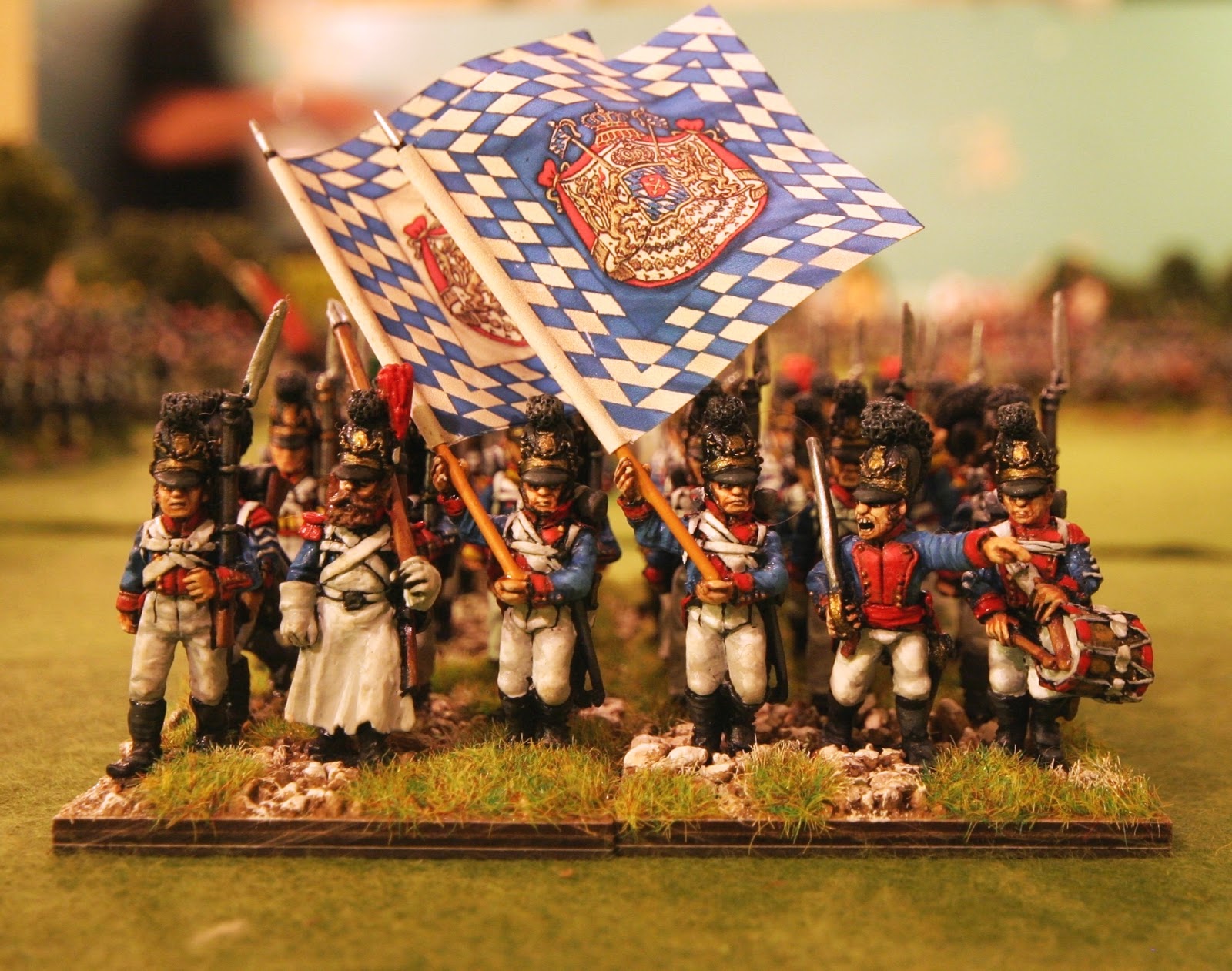
There were plenty of German allies in the Grande Armee at Borodino, these Foundry Bavarians make good proxies!
Painted by Nigel Cox, based by me for me. GMB flags.
Hi Paul, these are for you. |
In approaching Borodino yet again I had to make some
decisions about player numbers. We know other Napoleonic players and many we
don’t know keep asking to play with us! The fact is that to play this over a
few days properly we need people who know the rules and know how we play; we
can’t be nurse-maiding newbies on a stage like this; Borodino isn’t a dress
rehearsal! Almost more importantly we go back a long old way as players &
chums, Rich and I over 30 years now, so we can be a little cosey, closed or cliquey –
not everyone gets our sense of humour or engages with the group dynamic as we’d
like. For all these reasons the game had to be between the four of us – the
hardcore Marauders.
So, I had to design a massive Napoleonic multi Corps gaming
experience that usually occupies about 16 players over 2 or 3 days on a 28 x 15
table with 1000’s of toys. There are four of us; we have only a 16 foot table and not
enough models – time to compromise? No,- time to design.
 |
Pavlov Grenadiers line out to support the Fleches. Foundry models painted by Tony.
Hand rolled copper flags hand painted by Tony, finials by Bicorne. |
 |
A Russian Grenadier battalion mans a Fleche. Foundry models by Tony, Uhlans support to the rear.
Hand rolled copper flags hand painted by Tony, finials by Bicorne. Snapdragon earth works. |
 |
Russian 12lb foot battery at the southern end of the Semenovskaya ridge.
Numerous Grenadier battalions deploy behind them. Despite massive pressure & massive casualties the Grenadier Division was instrumental in protecting this small sector of the line from vast French cavalry formations & continuous artillery fire. |
The first decision was to play our Borodino in 28mm keeping
to the spirit of the original Gilder article. We might have squeezed enough
15mm toys out of the boxes and drawers but hey – I wanted the big toys on show.
This set in motion a series of purchases and painting which advanced our
collections in leaps and bounds.
How would we do this game? Basically I decided to break the
battle up into two sectors. The northern half contained Borodino and the Grand
Redoubt, the southern sector contained The Fleches and Utitsa. I also threw in
the precursor Battle of Shevardino as an appetiser. The decision to break it up
suited us in every way. We could use Marauder HQ to stage the game rather than
hiring a hall or somewhere like Triple Helix, this saved us money and
travelling time and far less packing etc. It also meant we were private and
didn’t have oddball spectators or snotty kids pissing around which can happen
at some public venues – after all this wasn’t a demo game. It also gave us the
choice of when we could play as opposed to fitting in with a venues scheduling.
We spread the games out over about 6 months, the final game being played over
the weekend closest to the bicentenary anniversary which happened to be my 45
th
birthday weekend too – HAPPY BIRTHDAY ME!
 |
The Russian centre as the storm breaks. French columns from Davout's 1st Corp emerge from the tree line to take massive casualties from the Grand Redoubt's 12lb battery; 7 casualties on one battalion - 4 on the one behind - ouch! In the background the French Grand Battery keeps up a murderous long range bombardment with 8 Guard 12lb guns on the ridge line. French horsemen are winning the cavalry battle to clear the southern flank of the Russian centre.
Note the pontoons, Renedra plastics and the imposing Grand Redoubt superbly modelled by my fair hand. |
 |
| A closer shot from a slightly different angle of the Russian centre. The French set foot on the earthwork and prepare for the assault. Russian infantry literally queue up to fight off the forces of the upstart Corsican tyrant who has defiled Mother Russia's sacred soil. Getting a bit heavy perhaps but that's how it was back in the day! |
 |
Russian General of Artillery Kutaisov selects targets through his telescope resplendent in his white uniform.
Foundry models converted and painted by Tony - lovely work. |
Tony had to be Kutusov. He’s our Russian player with all the
Russian toys. Rich also fancied being Russian so that meant Chris and I were the
Frenchies. I wanted to be Napoleon as Chris was Boney last time – no other
reason.
Splitting the game into two events effectively doubled the
amount of players, the toys, the table top space and the time available too. A
handy force multiplier.
The armies involved at Borodino were vast so even with
effectively four commanders per side each player still had an awful lot of
stuff to push around and keep track of. This is another reason to limit player
numbers in our view. We want to play with big forces; the strain of running so
many brigades and battalions creates a strain and stress that are real –
tangible. You need to be under pressure, to be barely able to cope, or simply
not cope. That’s when your stamina and concentration are tested, your decision
making is brought under scrutiny and you make mistakes – that’s
fog of war in gaming terms. Deploying
large formations into the landscape brings a whole new understanding of space and
manoeuvre. I don’t want to be given a division on a 4 foot frontage in a game
like this; I want to be ordering whole Corps to their doom, slapping down a
reserve Heavy Cavalry Corps and bringing up the Guard – that’s wargaming in the
Grand Manner like Peter Gilder in my book! Living the dream. I can assault a
village with 10 battalions any week night – this needed to be special.
 |
This General Sievers, a Russian Cavalry Corps commander. He is attended by members of three cavalry regiments, two of Dragoons, one of Uhlans. A powerful formation.
Foundry models converted and painted by Tony. |
The diaries were booked-up and the order of games decided.
Domestic arrangements negotiated...
The next design hurdle was the terrain and the table top
layout. I have read & reread many accounts of Borodino, poured over maps
and analysed orders of battle. I have sought out scenarios for refighting it
and contemplated how to do this on and off for over twenty years. The fact is I
cannot improve on the scenario provided by that article that got me into this
mess in the first place. Maybe I don’t want to either. That’s the game I want
to play – I can’t, so I’ll get as close to it as I can
*. Marauder
HQ has plenty of space for our permanent 16 x 6 foot table; we can do 20 x 6
foot at real squeeze but don’t have to. We can’t do 28 x 15 so by splitting the
game we need only 14 feet length, and the central 6 feet of the 15 foot width.
The rear areas are handled on maps which will cover the rear tables as used in
the Gilder game; this is where reserves are marshalled and manoeuvred. The map
with the scenario was drawn by Pete Morbey of Elite Miniatures, I think, and
shows all the relevant features. Critically this is a wargames map not a geographical
map so it is much easier to put down hills, woods, streams, villages, redoubts
etc. I always struggle with historical maps of battles but once someone has
turned it into a wargames table everything falls into place – this maybe a
medical condition – be interested to hear more on that (not really). The final table tops were both 16 x 6 which is
4 feet longer than the original; an extra foot was added to each end of the
northern table and two feet added to north end of the southern table – make
sense? This happened because I wanted some extra space to move about and not
just have a line ‘em up and go style game and secondly because we could! Time
would tell that this was possibly a mistake...
* the fact is that we could just go to the Wargames Holiday Centre and play this - we didn't! We should go along at some point to sample gaming "In The Grand Manner".
 |
General Duka commander of Russian Cuirassiers.
Another conversion and paint job by Tony.
Foundry models. |
The Mortimor Street Marauders have an extensive collection
of scenery so we could handle most of what was required. Last year we purchased
26 foot modular ridge from TSS, it is very versatile and crops up in sections
in most of our games; Borodino would be no exception. Trees? We have hundreds!
In this case we decided to use the posh trees which Tony picked up from Last
Valley some years ago, ,they are very effective and rather less uniform than
our S&A scenics’ stock. Tony also painted up a Snapdragon Studio Russian
village some while ago, we use it a lot as it is sooooooooo good, and we love
it! That was the obvious candidate for Borodino & Utitsa as well. Two
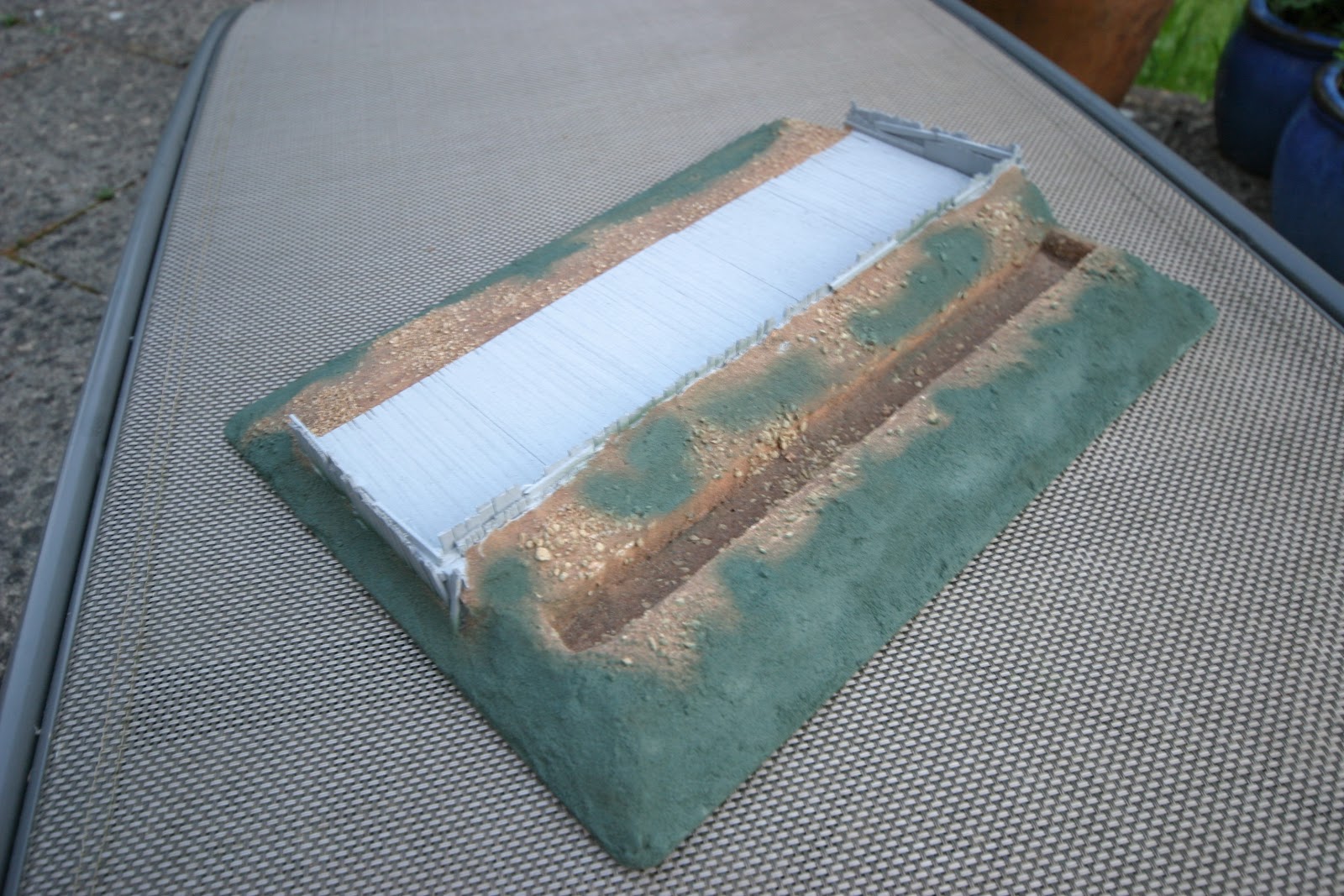
things we didn’t have were Grand Redoubt and a stream! The Redoubt I decided to
build myself and am very pleased with the results even if I say so myself. There
is an entire post on this blog devoted to that building project so have a peek.
The stream was something we needed to run across virtually the entire front
line from behind the Russian left crossing the Fleches, through the woods in
front of the Grand Redoubt and finally joining the Kolotcha River west of
Borodino. I bought 15 feet of stream from S&A Scenics as they provided our
river system and a useful linking piece too. I considered building the Fleches
but frankly we have some Snapdragon Studio revetments which are ideal so didn’t
bother.
Staying with the table top we did one other thing which was
crucial to the game. We set up the table some weeks before the game and took
many piccies and then Tony very carefully measured everything out so we could
prepare accurate maps to deploy our forces on in preparation. This may sound a
bit anal and maybe it is, however experience has shown us that paper maps
rarely correspond to the exact placement of scenery on the table top and things
can go down just plain wrong when resetting the board for play! For such a big
occasion Tony felt we should get this right for a change – I applaud that
decision and would do it again.
So the commands were decided, the scene set as it were, now
we just needed the armies involved and a plan; preferably a cunning plan,
infact a plan so cunning it could have been devised by the most cunning planner
ever.
 |
The 5th Hussars demonstrating near the village of Borodino.
Perry plastic Hussars, painted by Tony Laughton, (horses by me, based by me).
Flag by GMB. A very pretty regiment, one of my faves. |
Much like the terrain situation I have perused many orders
of battle for Borodino over the years, historical and of course many wargamers
interpretations. Suffice to say I went back to the article and simply used the
armies as printed. These present the Napoleon’s Grand Armee and both 1st
and 2nd Armies of the West under Kutuzov. The Russian Life Guard
Corps was attached to one Russian army but I allowed it to be allocated to either
Northern or Southern sector as Tony saw fit. I'll include the army lists in the following reports.
The lists are for “In The Grand Manner” and operate at
Corps level. We use General De Brigade which seem to have evolved from or at
least been inspired by ITGM so very few changes were needed. The main
difference would be in the command structure.
Ours looked & worked as follows;
Napoleon and Kutuzov would play no part other than initial
deployment of Corps and initial orders and the release of some reserves.
Neither took much part in the Battle so sod ‘em both. ITGM emphasises Corps
command whereas GdeB is as one might expect a Brigade level game. I wanted something
in between – Divisional would do! In reading the excellent notes on running big
games by Dave Brown in the GdeB rulebook it suggest that beyond the C in C
Corps Commanders needn’t be included and that the scaled division can be
handled as a brigade although we call it a Division. This allowed us to do what
I wanted. So for instance Junot’s Corps would comprise two Divisions each of 4
four battalions commanded by Ochs and Tharreau. This formation had an attached
light cavalry regiment and a foot battery, in all probability one division gets
the guns the other the cavalry – no need to have Junot represented as the C in
C directly orders the Divisional generals. This did however mean that an awful
lot of generals were required.
 |
The charge of the Westphalian Cuirassiers - Borodino 1812.
Perry plastics with hussar plumes. Painted by Perry Pender and me, based by me.
Generals by Front Rank by Perry Pender, based by me. Flag from the web somewhere... |
A further tweak was added thus; the French were allocated
more C in C’s than the Russians. These were Davout, Ney, Eugene and
Poniatwoski. In game terms this meant that in the northern and southern sectors
the French had a C in C for each player which seemed vital in the attack and
meant they could respond quicker to change orders than the more ponderous
Russians who had Barclay de Tolly and Bagration as C in C’s plus the commander
of the Life Guard Corps held in reserve, in effect only one senior commander
per sector and a spare who was off table and could only affect one sector if
called upon at all. This seemed correct in game balance terms – especially as I
was playing French!
Needless to say the army lists are rationalisations of the
real formations but they fit a Corps and Divisional sub structure very well.
Even with the French having a more efficient command system
the player generals would be stretched over space and time forcing some tough
decisions about where to be and when, exactly what I wanted.
The Peter Gilder lists involve a lot of 28mm toys nevertheless
we found that between three of us we had more than enough when the game was
broken into north and south sectors. Tony has his two collections of Russians
plus my Russian Life Guard Corps and by combing my French with Rich’s plus his considerable
French Imperial Guard we could do it!
(A foot note here may help. Chris’s Napoleonic 28mm
collection is a massive “work in progress”. He is tackling the Austrian
elements of the Army of Bohemia 1813 in conjunction with me. We have the toys
purchased and some are underway right now; about half of the 1400 odd foot are
done and the cavalry begun plus one battery completed. This is a really
exciting project which will unfold over the next twelve months. Before I do too
many Austrians I want to finish the Bavarian Division, the Poles and conclude
the Prussian project. Aaaaarrrgh – so much to do, so little time and money!!
 |
| The cover of the magazine that got me started on this long and weary road all those years ago. It looks so innocent now, no hint of the additively dangerous content waiting within. In this day and age such publications have a health warning. Look away now dear gentle friend, look away! |
Back on track now....Depending on the final deployment we
won’t have to proxy much if anything. We have about 100 renaissance
Cossack/Tartars who will do perfectly well as Napoleonic cossacks. We are 3 battalions short on
Russian Guards but I have 3 Prussian Guard battalions which will do nicely and carry similar flags. Beyond that we are there – wow!
Now we settled into a period of tactical planning. Rich and
Tony met up and chatted in secret whilst Chris and I did the same. We no doubt jockeyed
for the larger formations and best lines of attack and negotiated reserves. We
also attempted to predict what crazy scheme Tony and Rich might concoct to
thwart us! Rich has no understanding of hold
orders or defence what so ever,
for example he would have Wellington attack at Waterloo rather than cling
passively to a ridge line. However even our most outlandish predictions proved
way off the mark! Could Kutuzov’s order of the day really have been “Take
Paris”!
I made a lot of assumptions about player understanding of the battle and the historical use of Guard formations and reserves, needless to say I shouldn't have done.The French had a free reign to deploy as they wished; the Russians had to deploy the 1st and 2nd Armies of the West in their entirety one per table topsector with the Life Guard detached to support either one as determined before game 1. Next time I prepare a big game I will be much clearer and more prescriptive about reserves and deployment.
Finally the planning was over and the first weekends gaming
arrived. Would it all be worth it? Had I created a gaming experience that could
engage & entertain us for four days over two weekends? That’s what the next
two parts are all about, so pop back.
P.S. astute readers will recall that in designing this
series of games I wanted to include the precursor to Borodino – The Battle of
Shevardino fought a few days before. Well, I used another article, this time
penned by Barry Hilton and published in Wargames Illustrated. This is quite a large
game in itself so Tony and Chris played it between them, allowing two days to
finish it. Sadly it was over very, very quickly. The Russian Corps stationed to
defend the position was totally overwhelmed and swept aside in no time. Sadly
this was one of those rare “non games” which just don’t go right. The scenario
is sound enough; a simple case of "shite dice versus miracle dice" on the day! These things
happen sometimes, mercifully not too often.
P.P.S. The Wargames Holiday Centre still exists under the expert hand of Mark Freeth in Basingstoke, UK. We should really get our arses in gear and visit him sometime soon. I watch his videos on youtube and visit his site most days - always inspirational, always.






.JPG)


